
Histoire sommaire du développement des organisations de résistance dans le Département de la Manche :
1940 :
- Le 17 juin, après avoir rencontré le Capitaine STANLEY, de l’Intelligence Service, Maurice MARLAND, à Granville, accepte de développer un réseau de renseignement, principalement sur les côtes, jusqu’à Saint MALO. Opérationnel dès l’été, ses premiers courriers pour LONDRES emprunteront la voie maritime à partir des côtes nord de la Bretagne.
- En août, le Capitaine Maurice DUCLOS, des Services secrets de la France libre (future B C R A) débarque de nuit sur la plage de Saint-Aubin dans le Calvados pour développer un grand réseau de renseignement sur l’ouest de la France, et notamment sur la Normandie. La branche de ce réseau, sur le Département de la Manche, sera dirigée, à partir de mars 1941, par Jacques BERTIN de la HAUTIERE, Officier pilote de l’aéronavale, en congé d’armistice.
Sur initiatives individuelles de cadres civils ou d’anciens militaires, une dizaine de petits réseaux essaient de s’organiser mais ils seront vite démantelés par manque de soutien, de professionnalisme ou par le fait de dénonciations.
Compte tenu de l’importance de Cherbourg, avec son port militaire, de futurs grands réseaux comme Confrérie Notre Dame, du Colonel REMY, de la France libre, et ALLIANCE du Colonel LOUSTANAU-LACAU auront, dès 1940, des agents de renseignement dans le Nord-Cotentin.
Ces antennes n’ont pas pour mission de développer leur réseau sur le territoire départemental, elles sont essentiellement tournées vers le renseignement militaire maritime.
Dans cette période initiale de la guerre, l’organisation des réseaux de renseignement reste de type classique en se structurant autour de 3 fonctions essentielles :
- La fonction Renseignement (S R),
- La fonction Contre-Espionnage (C E),
- La fonction Chiffre et Logistique.
Pour devenir opérationnels, les agents qui tiennent ces fonctions doivent recevoir de solides formations, en particulier l’opérateur radio affecté à la fonction chiffre, constamment traquée par les unités de détection goniométrique allemandes.
Par ailleurs, dans le Nord et le Sud du département, le Parti Communiste, dissous pendant la « Drôle de Guerre », se reconstitue clandestinement pour se transformer en Front National, mouvement qui sera, dès 1941, à l’origine des Groupes de résistants appelés Francs-Tireurs et Partisans.
1941 :
- Sous l’autorité de Jacques BERTIN de la HAUTIERE, le réseau SAINT-JACQUES s’implante principalement sur la presqu’île du Cotentin.
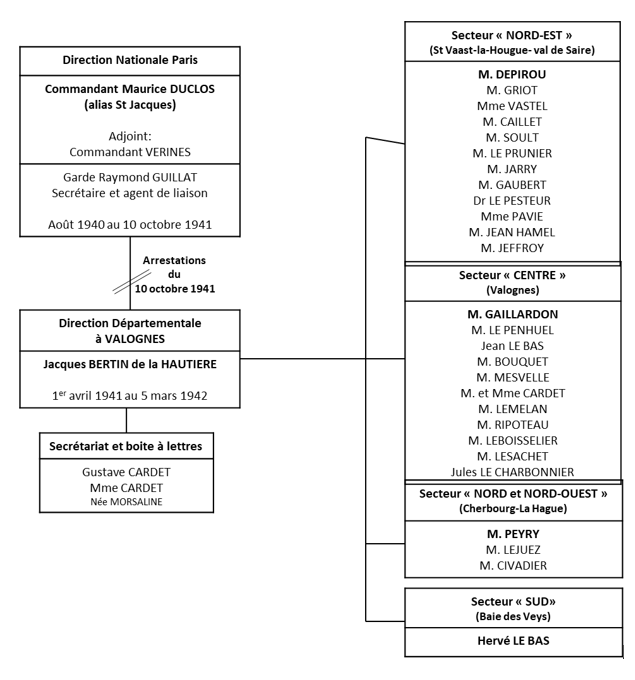
Il est opérationnel à partir du mois de mars 1941 jusqu’au 10 octobre, date des grandes arrestations qui le démantèlent en région parisienne et le privent du Commandant VERINES, son chef pour la Normandie.
Monsieur de la HAUTIERE ayant échappé miraculeusement aux arrestations, son réseau reste intact mais sans liaison avec Londres, celle-ci étant de la responsabilité de l’Etat-Major parisien du réseau.
En effet, pour la Normandie, les réseaux de renseignement rattachés à la France libre bénéficient d’une liaison aérienne par Lysander pour acheminer leurs courriers vers l’Angleterre à partir de terrains situés sur le département de l’Oise ou dans le Vexin.
Le Groupe MARLAND poursuit son développement avec l’Intelligence Service et porte ses effectifs autour de 80 agents.
Après l’invasion de l’Union soviétique, le 22 juin, le Front National du parti Communiste accélère la transformation de ses cellules sur le terrain en groupes de résistants qui reçoivent comme consigne de passer à l’action armée immédiate contre l’ennemi fasciste ou nazi.
La demande vient des dirigeants de l’Union Soviétique qui veulent à tout prix soulager la pression allemande sur leurs armées. Désarmés et insuffisamment formés, les résistants communistes prennent des risques considérables pour eux-mêmes et pour la population pouvant être victime de représailles.
Peu d’actions seront tentées, en grande partie contrariées par une vague d’arrestations préventive au cours de l’été et de l’automne. Celles-ci ayant été largement facilitées par le « fichage » des militants communistes rendus suspects après la signature du Pacte Germano-Soviétique.
1942 :
C’est l’année où la Résistance s’étend et s’organise sur l’ensemble du Département.
Le groupe MARLAND va dépasser la centaine d’agents et découvrir que servir l’allié britannique a des limites. Des informations d’ordre politique, notamment sur les autorités et l’administration de l’Etat français devraient être dirigées en priorité vers le chef de la France libre, alors que l’Intelligence-Service est servie en premier. Cette anomalie va motiver son rapprochement puis son intégration dans le réseau BRUTUS de la France libre en début d’année 1943.
Isolé, l’ex-réseau de Jacques BERTIN de la HAUTIERE va connaître un renouveau exceptionnel à l’issue d’une rencontre à Paris au mois de mars avec les dirigeants du Mouvement « Organisation Civile et Militaire » (O C M) et du réseau CENTURIE que ce mouvement développe dans le Nord de la France.
Au service de la France libre, le mouvement et son réseau recrutent chez les cadres qui amènent toujours des subordonnés pour accepter la discipline et l’organisation militaires imposées.
Après avoir difficilement convaincu ses principaux adjoints, Jacques de la HAUTIERE doit se présenter à ses nouveaux chefs, à la tête de l’Etat-Major régional du réseau CENTURIE à Caen, afin d’y recevoir sa mission.
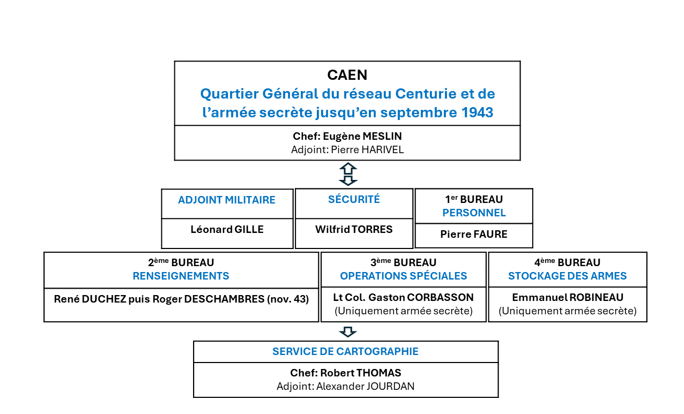
Cette mission consiste à :
- Organiser un Service de Renseignement et d’Action sur l’ensemble du Département de la Manche et selon les principes suivants :
- Une organisation sectorielle,
- Par secteur, un chef avec 3 chefs de groupe subordonnés,
- Par groupe, 3 chefs d’équipe : Renseignement, Contre-Espionnage et Action-Armée, soutenues par des agents de liaisons et des boites aux lettres.
- Former, au plus tôt, avec le soutien de l’Etat-Major, les agents destinés au Renseignement et au Contre-Espionnage, le renseignement étant la mission prioritaire consistant à bien connaître l’Ennemi dans toutes ses composantes et à répondre aux demandes particulières du Commandement allié.
Afin d’éviter des représailles faciles par l’Ennemi, l’Action-armée est strictement réservée à l’élimination des collaborateurs les plus dangereux pour les agents du réseau, la décision appartenant à son Chef ou à son adjoint.
Néanmoins, l’Action-armée doit être préparée dans la perspective d’un débarquement allié sur les côtes de la Manche.
Deux difficultés majeures apparaissent pour la réussite de cette mission, le recrutement de cadres expérimentés d’abord et le manque cruel d’armement ensuite, l’espoir se tournant vers des parachutages opportuns en provenance d’Angleterre.
Au titre du Renseignement, les informations recueillies vont subir 3 séries de traitement entre leurs lieux de collecte et leur arrivée au siège de la France libre à Londres.
Après vérification au niveau du secteur, elles sont analysées, triées et classées, notamment en fonction de l’importance et de l’urgence, au niveau départemental puis, au niveau régional et enfin, à l’antenne parisienne du B C R A.
Plus de 90% des informations sont regroupées dans des courriers, confiés à des convoyeurs, résistants, recrutés, le plus souvent, chez les postiers ou les cheminots, qui empruntent les voies ferrées entre la Manche et Paris.
Sous réserve d’impossibilités techniques, les renseignements les plus urgents sont envoyés par Emission-Radio ou pigeons-voyageurs.
L’Antenne parisienne du B C R A comprend, notamment, des opérateurs-radio permanents, camouflés en banlieue, servis par des équipes logistiques qui les déplacent de refuge en refuge après chaque émission.
Pour le réseau CENTURIE de la Manche, M. de la HAUTIERE dispose de :
- Charles COMESSE, opérateur-radio, camouflé dans la région de Saint-Côme-du-Mont, à utiliser en cas d’absolue nécessité, ce qui fut le cas, 48 h avant le Débarquement, afin de signaler la concentration d’unités allemandes dans la région de Carentan,
- Jean PICOT, agent particulier, sous l’autorité du chef départemental, est chargé des liaisons entre les réseaux CENTURIE de la Manche et du Calvados. Il est, par ailleurs, colombophile au service des secteurs manchois tout en étant fermier sur la commune de Neuilly-la-Forêt, au nord de Lison.
En mai 1944, la dernière grande mission pour ses pigeons fut d’envoyer, en Angleterre, sur calques appliqués sur une vieille carte Lambert, des mesures de hauteur d’eau, prises dans les prairies inondées, à proximité des zones de largage retenues pour accueillir les troupes aéroportées dans la nuit du 6 juin 1944.
Parvenues à l’Etat-Major Allié à Londres, les informations fournies par la Résistance, donnent le plus souvent naissance à des questionnaires qui réclament aux agents sur le terrain, des renseignements complémentaires, fréquemment, dans des délais très courts. Ils sont souvent obligés d’aller chercher le Renseignement au plus près de l’Ennemi en prenant parfois de gros risques.
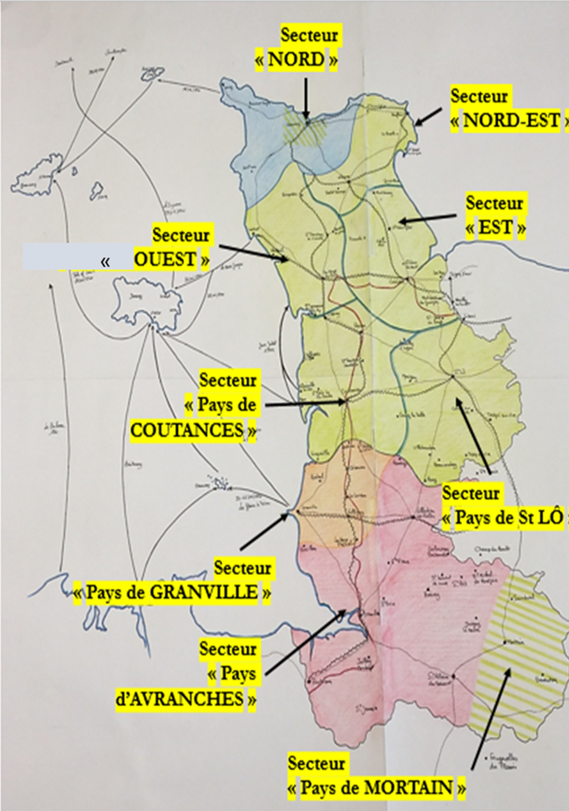
En s’appuyant sur l’implantation de son ancien réseau Saint-Jacques, M. de la HAUTIERE met sur pied 4 secteurs du réseau CENTURIE sur la presqu’île du Cotentin, son Poste de Commandement étant installé à Valognes avant de le fixer définitivement au Château de GARNETOT sur la Commune de Rauville-la-Place.,
Au cours de l’été, après avoir recruté des cadres expérimentés dont le Commandant VILLIERS-MORIAME, nommé chef de secteur, il étend le réseau sur le Pays de Saint-Lô, source très importante de renseignements avec la capitale administrative du Département. En outre, compte tenu de son expérience, il lui accorde une délégation de pouvoir pour suivre la mise en place du réseau sur le Pays de Coutances et sur le Sud du Département. Cette délégation le conduit à lui donner le pouvoir de traiter les renseignements provenant du Sud et du Centre Manche, avant de les adresser directement à l’Etat-Major de Caen.
L’installation du réseau CENTURIE, sur le Département, est effective dès l’automne, alors que l’Union des Mouvements de Résistance voulue par le Général de Gaulle et son délégué, Jean Moulin, commence à produire ses premiers effets.
Pour la Manche, sous l’impulsion de René SCHMIT et de Raymond LECORRE, les agents du mouvement Libération-Nord acceptent de renforcer le réseau CENTURIE en s’intégrant dans ses groupes.
Par ailleurs, en application de la circulaire du 22 octobre 1942 du Général de Gaulle, adressée à Jean Moulin, tous les résistants isolés ou rescapés d’organisations démantelées sont invités à rejoindre les grands réseaux.
De son côté, le Front National qui rassemble tous les groupes de résistants communistes, recrute et se structure au cours du 1er semestre 1942. Ses efforts seront brisés par une nouvelle série d’arrestations qui démantèle ses unités dans le Nord et le Centre de la Manche. Intact et bien implanté dans le Sud du département, il va s’y imposer très vite par son autorité et son efficacité.
1943 :
C’est l’année où la Résistance départementale devient vraiment opérationnelle. Le rendement des services de renseignement ne cesse de croître au fil des mois. Apprécié à partir du volume des courriers adressés au siège du B C R A à Londres, la quantité des renseignements évolue selon une courbe exponentielle.
Il en est de même pour la qualité du renseignement et sa précision. A la fin de l’année, le Colonel DEVAWRIN, chef des services secrets de la France libre, connaît la position des unités allemandes, le long des côtes de la Manche, jusqu’au niveau du Capitaine qui commande une compagnie de 150 hommes !
Sans oublier la part qui revient toujours à la chance, c’est un résultat exceptionnel obtenu sans aucune arrestation chez les agents sur le terrain, grâce à la formation reçue dans une discipline librement consentie.
Sur le Département de la Manche, c’est le fruit du travail des réseaux CENTURIE et BRUTUS, les Groupes de Francs-Tireurs et Partisans du Front-National, se réservant l’Action-armée contre l’Ennemi, pour agir dès l’automne, notamment dans les secteurs d’Avranches et de Mortain.
Ces groupes vont connaître une 3ème vague d’arrestations dans le Nord et le Centre du Département au point de les rendre inopérants à la veille du Débarquement, seuls les groupes du Sud-Manche ayant été épargnés.
Compte tenu de la solide implantation de ces derniers et de leur antériorité notamment, le réseau CENTURIE ne peut mettre sur pied qu’un groupe important autour de Mortain et un groupe centré sur La Haye Pesnel-Bréhal pour le Pays d’Avranches.
Sur des motifs liés à la géographie et à la dispersion de ses agents sur le Pays d’Avranches, le Mouvement Libération-Nord est dans l’impossibilité de mettre sur pied une organisation intégrée avec le réseau CENTURIE. Jusqu’à la Libération, il conserve 2 groupes de résistants, implantés pour l’un autour d’Avranches et l’autre autour de Saint-James.
Les renseignements qu’ils fournissent sont traités par le réseau CENTURIE pour rejoindre Saint-Lô et Caen et, dès l’annonce du Débarquement, les équipes Action-armée seront invitées à rejoindre, pour emploi, les groupes F T P F les plus proches.
1944 :
Constatant le recul des armées allemandes sur tous les fronts, la Résistance sent que le temps de la Libération du Territoire national approche. Mouvements et réseaux se mobilisent pour organiser l’insurrection armée dès l’annonce d’un débarquement.
De manière générale, les besoins en cadres formés et en armement sont très importants. C’est le cas pour la Résistance départementale qui dispose, notamment dans le Nord du Cotentin, d’une petite réserve d’armes récupérées sur l’Armée française de 1940.
Très bien représentée chez les carriers du Sud-Manche, la Résistance communiste récupère très tôt de l’explosif qui servira notamment dans les coupures de voies ferrées.
Dès l’annonce du Débarquement des Alliés sur les côtes de France, des parachutages d’armes sont prévus et confirmés par des agents français du Spécial Opération Exécutive ( S O E ) en poste en Basse Normandie ou en Mayenne.
Le réseau CENTURIE départemental doit bénéficier de 3 parachutages à Sainte-Marie-d’Outre-l’Eau, à l’Est de Pont-Farcy, mais une seule opération aura lieu le 10 mai 1944.
Il faudra donc « répartir la pénurie » sur les 6 secteurs opérationnels du Centre et du Nord du Département.
Quant au Sud-Manche, il va bénéficier du large soutien du S O E qui opère en Mayenne, avec l’envoi d’un conseiller technique, le Capitaine Eric HAYES, qui obtient, autour de Fougerolles du Plessis, des parachutages permettant de doter tous les groupes et principalement ceux des F T P F.
Les plans de coupure des communications téléphoniques, ferroviaires et routières – imposés par les Alliés, seront appliqués dans tous les secteurs, en fonction de leurs moyens disponibles.
Mieux dotés en armement et explosifs, les groupes des Pays de Mortain et d’Avranches ont déclenché l’Action-armée, notamment sur les voies ferrées, dès l’automne 1943. Ils l’ont poursuivie au cours de l’hiver 1944 au point de provoquer des prises d’otages de la part des Allemands. Par ailleurs, sur ordre du Commandement Allié, afin qu’il soit renseigné sur l’importance des réserves allemandes, positionnées en arrière du Front, ces groupes fourniront une vingtaine d’agents, agissant en binôme, pour remonter vers le Nord du Cotentin en franchissant la zone des combats. Sous le nom de mission HELMSMAN, cette opération connaîtra un réel succès et marquera tous les résistants du Sud du Département.
A brief history of the development of resistance organisations in the Department of the Manche :
1940 :
- On June 17, after meeting Captain STANLEY, of the Intelligence Service, Maurice MARLAND, in Granville, agreed to develop an intelligence network, mainly along the coasts, as far as Saint Malo. Operational from the summer, its first couriers to London were planned to take the route by sea from the northern coast of Brittany.
- In August, Captain Maurice DUCLOS, of the Free French Secret Services (later BCRA) landed at night on the beach of Saint-Aubin in Calvados to develop a large intelligence network in the west of France, and in particular in Normandy. The branch of this network, in the Manche Department, would be led from March 1941 by Jacques BERTIN de la HAUTIERE, Naval Air Pilot Officer, on armistice leave.
On the initiative of individual civilian executives or former military personnel, a dozen small networks attempted to organise themselves, but were quickly dismantled through lack of support, professionalism or because they were denounced.
Given the importance of Cherbourg, with its military port, future major networks such as Confrérie Notre Dame, founded by Colonel REMY, that of Free France and the ALLIANCE of Colonel LOUSTANAU-LACAU would have intelligence agents in the North-Cotentin from 1940.
These branches were not charged with developing their network within the territory of the Department, but focused mainly on maritime military intelligence.
In this initial period of the war, the intelligence networks were structured in a conventional manner, around 3 essential functions:
The Intelligence function (SR),
The Counter-Espionage function (CE),
Encoding and Logistics function
To become operational, the agents who held these functions had to receive thorough training; in particular, the radio operators assigned to the encoding function, who were constantly tracked by the German goniometric detection units (radio direction finders).
In addition, in the north and south of the Department, the Communist Party, dissolved during the “Phoney War”, was reconstituted in secret, morphing into the National Front, a movement that, from 1941, would be at the origin of the resistance groups called “Francs-tireurs” (free riflemen) and Partisans.
1941 :
Under the authority of Jacques BERTIN de la HAUTIERE, the SAINT-JACQUES network was mainly established on the Cotentin peninsula.
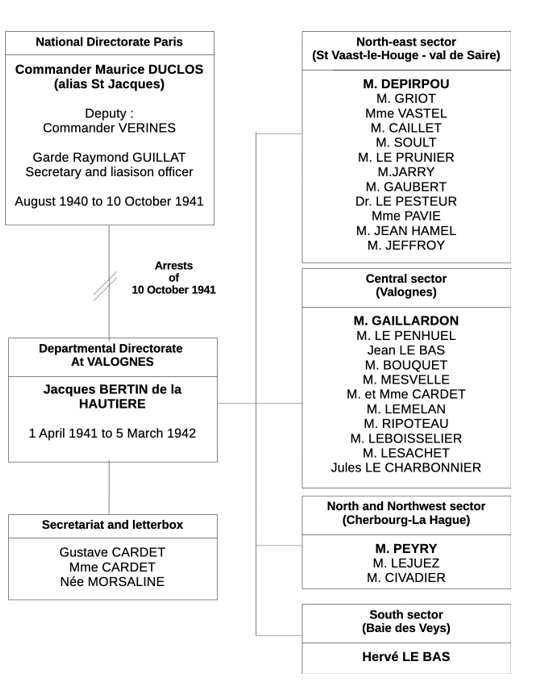
It was operational from March 1941 until October 10, the date of the major series of arrests that dismantled it in the Paris region and deprived it of Commander VERINES, its leader in Normandy.
Mr. de la HAUTIERE kept his network intact, having miraculously escaped arrest, but without a connection with London, which had been the responsibility of the network’s Parisian General Staff.
Indeed, for Normandy, the intelligence networks linked to Free France benefited from an air link by Lysander, routing their mail to England from locations in the department of Oise or in the Vexin.
The MARLAND Group continued to develop with the Intelligence Service and increased its workforce to around 80 agents.
After the invasion of the Soviet Union on June 22, the Communist Party’s National Front accelerated the transformation of its cells on the ground into resistance groups that were instructed to move on to immediate armed action against fascist or Nazi enemies.
The request came from the leaders of the Soviet Union, who wanted to ease German pressure on their armies at all costs. Unarmed and insufficiently trained, the communist resistance fighters took considerable risks not only for themselves but also endangered the population, who could become victims of reprisals.
Few actions would be attempted, largely frustrated by a wave of preventive arrests during the summer and autumn. These had been largely facilitated by the “profiling” of communist activists made suspect after the signing of the German-Soviet Pact.
1942 :
This is the year when the Resistance extended and organised itself over the entire Department. The MARLAND group would grow to over a hundred agents and discover that serving the British ally had its limits. Political information, in particular on officials and the administration of the French State, had to be directed as a priority to the head of Free France, while the Intelligence Service was served first. This anomaly would motivate its merger with and its later integration into the BRUTUS network of Free France at the beginning of 1943.
Isolated, the former network of Jacques BERTIN de la HAUTIERE would experience an exceptional renewal after a meeting in Paris in March with the leaders of the “Civil and Military Organisation” Movement (OCM) and the CENTURIA network, developed by this movement in the north of France.
In the service of Free France, the movement and its network recruited from the managerial classes, who always brought subordinates with them to accept the military discipline and organisation imposed on them.
After having convinced his main deputies, with difficulty, Jacques de la HAUTIERE had to present himself to his new leaders at the head of the regional staff of the CENTURIA network in Caen, in order to receive his assignment.
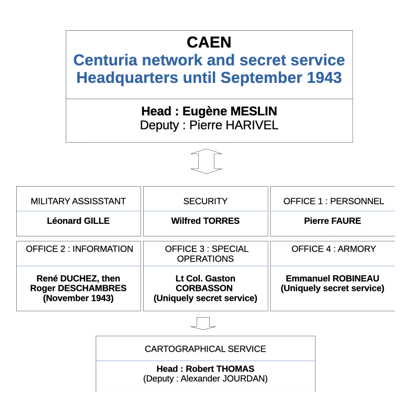
This assignment consisted of:
Organising an Intelligence and Action Service throughout the Manche Department and according to the following principles:
- A sectoral organisation,
- Per sector, a leader with three subordinate group leaders,
- Per group, three team leaders: Intelligence, Counter-Espionage and Armed Action, supported by liaison officers and mailboxes.
Training, as soon as possible, with the support of the General Staff, the agents for Intelligence and Counterintelligence, intelligence being the priority mission comprising knowing the enemy well in all its components and responding to the particular requests of Allied Command.
In order to avoid easy reprisals by the enemy, the Armed Action team was strictly reserved for the elimination of collaborators who posed the most threat to network agents, the decision belonging to its chief or deputy.
Nevertheless, the Armed Action team had to be prepared for an Allied landing on the channel coast.
Two major difficulties confronted the success of this mission: first the recruitment of experienced officers, then the acute shortage of weapons, hope turning to timely supplies, parachuted from England.
Turning to Intelligence: the information collected underwent three stages of processing between their collection sites and their arrival at the headquarters of Free France in London.
After verification at the sector level, they were analysed, sorted and classified, notably according to importance and urgency, at the departmental level, then at the regional level and finally, at the Parisian branch of the BCRA.
More than 90% of the information was compiled in letters, entrusted to couriers, who were members of the resistance, recruited, in the main, from postmen or railway workers, using the railway network between the Manche and Paris.
Except where prevented by technical difficulties, the most urgent information was sent by Radio Broadcast or carrier pigeon.
The Parisian branch of the BCRA included, in particular, permanent radio operators, concealed in the suburbs and served by logistics teams who moved them from one hiding place to another after each broadcast.
For the Manche-based CENTURIA network, Mr. de la HAUTIERE had available:
- Charles COMESSE, radio operator, concealed in the Saint-Côme-du-Mont region, to be used in case of absolute necessity, which was the case, 48 hours before the Landings, in order to report the concentration of German units in the Carentan region,
- Jean PICOT, a private agent, under the authority of the departmental head, who was in charge of the links between the CENTURIA networks of the Manche and Calvados. He was also a pigeon handler serving the Manchois sectors, while working as a farmer in the municipality of Neuilly-la-Forêt, north of Lison.In May 1944, the last major mission for his pigeons was to send tracings from an old Lambert map to England, showing measurements of the water height, taken in the flooded meadows, near the drop zones designated to receive airborne troops on the night of June 6, 1944.
Received by the Allied General Staff in London, the information provided by the Resistance most often gave rise to questionnaires requiring additional information from officers on the ground, frequently, in a very short time. They often required them to seek Intelligence as close as possible to the enemy, sometimes taking substantial risks.
Based on the implementation of his former Saint-Jacques network, Mr. de la HAUTIERE set up four sectors of the CENTURIA network on the Cotentin peninsula, his Command Post being installed in Valognes before fixing it permanently at the Château de GARNETOT in the Commune of Rauville-la-Place.
Over the summer, after recruiting experienced officers, including Commander VILLIERS-MORIAME, appointed head of sector, he extended the network to the Pays de Saint-Lô, a very important source of information containing the administrative capital of the Department. In addition, given his experience, he gave him the power to monitor the implementation of the network in the Pays de Coutances and in the south of the Department. This delegation led to the his having power to process information from the South and Centre of the Manche, before sending it directly to the General Staff at Caen.
The installation of the CENTURIA network, within the Department, was effective from the autumn, while the Union of Resistance Movements sought after by General de Gaulle and his delegate, Jean Moulin, began to produce its first results.
For the Manche, urged by René SCHMIT and Raymond LECORRE, the agents of the Libération-Nord movement agreed to strengthen the CENTURIA network by merging into its groups. In addition, in line with General de Gaulle’s circular of October 22, 1942, addressed to Jean Moulin, all isolated resistance fighters or survivors of dismantled organisations were invited to join the major networks.
For its part, the National Front, which brought together all the communist resistance groups, was recruiting and organising itself during the first half of 1942. Its hopes were dashed by a new series of arrests that dismantled its units in the North and Centre of the Manche. In the south of the Department, it remained intact and well established, and very quickly took hold through its authority and efficiency.
1943 :
This is the year when the Departmental Resistance became fully operational. The performance of intelligence services continued to grow over the months. Assessed from the volume of letters addressed to the BCRA headquarters in London, the quantity of information evolved exponentially.
The same applied to the quality and accuracy of the intelligence. At the end of the year, Colonel DEVAWRIN, head of the secret service of Free France, knew the position of the German units, along the coast of the English Channel, up to the level of Captain, commanding a company of 150 men.
This was an exceptional result, obtained with no arrests among the field agents, partly down to luck but also thanks to the training received, applied in a freely-accepted discipline.
In the Department of the Manche, the efforts of the CENTURIA and BRUTUS networks bore fruit; the Groups of Free-Riflemen and National Front partisans, holding back on armed action against the enemy, were operational from autumn onwards, especially in the Avranches and Mortain sectors.
These groups experienced a third wave of arrests in the north and centre of the Department to the extent of making them inoperative by the eve of the Landing; the only groups being spared were those in the Sud-Manche.
Considering that these groups were solidly organised and particularly long-established, the CENTURIA network was only able to set up an important group around Mortain, and a group centred on La Haye-pesnel-Bréhal for the Pays d’Avranches.
For reasons related to the geography and dispersion of its agents within the Pays d’Avranches, the Libération-Nord movement was unable to set up an integrated organisation with the CENTURIA network. Until the liberation, it maintained two groups of resistance fighters, one located around Avranches and the other around Saint-James.
The information they provided was processed by the CENTURIA network in order to reach Saint-Lô and Caen and, as soon as the landings were announced, the Armed Action teams were invited to lend their efforts to the nearest FTPF groups.
1944 :
Noting the retreat of the German armies on all fronts, the Resistance felt that the time of the liberation of the country was approaching. Movements and networks mobilised to organise the armed insurrection as soon as a landing was announced.
In a general sense, the need for trained cadres and weapons was very important. This was the case for the Departmental Resistance which had, especially in the north of Cotentin, a small reserve of weapons recovered from the French Army of 1940.
Very early on, the Communist Resistance, making up a large proportion of the quarrymen in the Sud Manche, recovered explosives that would be used in particular in disrupting railway lines.
As soon as the Allied Landings on the French coast were announced, parachute drops of weapons were planned and confirmed by French agents of the Special Executive Operation (SOE) stationed in Base Normandy or Mayenne.
The departmental CENTURIA network was to benefit from three parachute drops in Sainte-Marie-d’Outre-l’Eau, east of Pont-Farcy, but only one operation would take place on May 10, 1944.
It was therefore necessary to spread the shortage among the six operational sectors of the Centre and North of the Department.
As for the Sud Manche, this would benefit from the broad support of the SOE which operated out of Mayenne, and sent a technical advisor, Captain Eric HAYES, who received airdrops around Fougerolles du Plessis to equip all the groups and mainly those of the FTPF.
The plans to disrupt communications – telephone, rail and road – imposed by the Allies, was to be applied in all sectors, according to their available means.
Better equipped with weapons and explosives, the groups from the Pays de Mortain and Avranches had been carrying out Armed Action operations, especially on the railways, from the autumn of 1943. They continued through the winter of 1944 to the point of provoking the taking of hostages by the Germans. In addition, by order of the Allied Command, in order to be informed of the importance of the German reserves positioned behind the front, these groups were to provide around twenty agents, acting in pairs, to go up to the North of the Cotentin, crossing the combat zone. Under the name of the HELMSMAN mission, this operation would be a real success and would make a name for all the resistance fighters of the South of the Department.
DEFINITION des GEORGIENS
Le terme « GEORGIENS » recouvre 2 grandes catégories de soldats soviétiques qui ont servi l’Armée allemande de 1941 à 1945.
La 1ère catégorie est formée d’un nombre important de soldats originaires du Caucase ou d’Asie qui s’oppose au régime communiste imposé par Staline. Le noyau dur de cette catégorie est formé par les cadres et soldats de l’Armée VLASSOV qui veut aider HITLER pour libérer son pays du Communisme.
La 2ème catégorie est composée de soldats, prisonniers des allemands, qui acceptent de porter les armes, au profit de l’Allemagne, contre des conditions de vie identiques à celles des soldats allemands et d’affectations dans des fonctions de surveillance ou logistique.
C’est la situation des 2 Bataillons de GEORGIENS positionnés entre BREHAL et GEFFOSSES représentant un effectif global d’environ 1500 h.
En juillet 1944, au moment du repli allemand vers le Sud-Manche, ils éviteront les risques et préfèreront la capture tout en commettant quelques exactions, notamment, en s’attaquant à des femmes isolées pour s’emparer de leurs bijoux.
A la fin des hostilités, ils refuseront de retourner dans leur pays d’origine par peur de représailles.
Les accords de YALTA imposeront aux Américains de les rapatrier de force, sous escorte, jusqu’en Allemagne de l’Est et STALINE ordonnera de les envoyer en Sibérie où ils connurent une fin tragique.
DEFINITION of GEORGIANS
The term “Georgians” covers two major categories of Soviet soldiers who served in the German Army from 1941 to 1945.
The first category is made up of a significant number of soldiers from the Caucasus or Asia who opposed the communist regime imposed by Stalin. The hard core of this category was formed by the officers and soldiers of the Vladivostok Army who wanted to help Hitler to liberate his country from Communism.
The second category is composed of soldiers, prisoners of the Germans, who agreed to carry weapons, to aid Germany, in return for living conditions identical to those of German soldiers and with assignments in surveillance or logistical functions.
This is the situation of the two Georgian battalions positioned between Bréhal and Gefosses, representing an overall establishment of about 1500.
In July 1944, at the time of the German retreat to the Sud Manche, they avoided risks and preferred capture while committing some abuses, in particular attacking isolated women for their jewellery.
At the end of hostilities, they would refuse to return to their country of origin for fear of reprisals.
The YALTA agreements required the Americans to repatriate them by force, under escort to East Germany and Stalin ordered to their exile to Siberia where they met a tragic end.